top of page

My Father's Memory
This is a Paragraph. Click on "Edit Text" or double click on the text box to start editing the content and make sure to add any relevant details or information that you want to share with your visitors.

1. March 19, 1921 My Kopacsi grandparents’ were wedded. A year later on March 5, 1922 my father, Sandor Kopacsi, the only child of my grandparents were born. Grandmother Ilona started labor in the Miskolc National Theatre during the second act of an operetta called The Barbarian
Invasion. my father’s arrival became rather symbolic; during his lifetime he survived two Barbarian Invasions, (in 1944 with the Germans and in 1956 with the Russians), and he took active part in fighting against both of them.
Invasion. my father’s arrival became rather symbolic; during his lifetime he survived two Barbarian Invasions, (in 1944 with the Germans and in 1956 with the Russians), and he took active part in fighting against both of them.

2. My father’s fondness of firearms is evident from an early age. Even at the age of ten he is armed and ready to face whatever may come his way. But judging by the little dog sniffing behind him, his menacing looks can be deceptive.

3. My mother at the age of sixteen standing behind my maternal grandmother and my mother’s little sister, Eva. I never met my grandmother and little Eva, as they were deported and killed in Auschwitz in June 1944. It became a festering wound for my mother that my grandmother refused to be hidden and rescued by my father and his parents.

4. October 24, 1943, the day of my parents’ engagement. Besides my
father’s parents, my mother only shared the news of their engagement
with Aunt Linka, a distant cousin of my maternal grandmother, who
didn’t believe that religion should be a major issue when it came to
marry someone for love. From that day on they fought hand in hand, taking turns on saving each other‘s lives.
father’s parents, my mother only shared the news of their engagement
with Aunt Linka, a distant cousin of my maternal grandmother, who
didn’t believe that religion should be a major issue when it came to
marry someone for love. From that day on they fought hand in hand, taking turns on saving each other‘s lives.

5. A few short weeks after Germany invaded Hungary on March 19, 1944; my Kopacsi grandfather was arrested by the Gestapo. On that day my parents were forced to leave home and stayed with a friend who lived close to the steel factory where my father was working.

6. In August 1944, when my grandmother was warned that the Gestapo went looking for the list of subscribers of the Voice of the People, a socialist daily newspaper at my Kopacsi grandparents’ home, they knew it was time to disappear from Miskolc. My Grandmother, my father and my mother snuck on the train and managed to travel to the prison camp to Nagykanizsa, where my grandfater was ‘working’ in the internment camp. Colonel Deményi, the Commander of the prison camp, who hated the Nazis, and had great respect for my grandfather, greeted them with open arms after my grandfather told him that our family had lost everything in the most recent Allied air raid of Miskolc. The picture is taken in the garden of the Commander’s manor.

7. My Kopacsi grandfather is released from the prison camp September 1944 and the family returned to Miskolc. But instead of reporting to the police upon his return, the family decided it was wiser for them to remain in hiding.
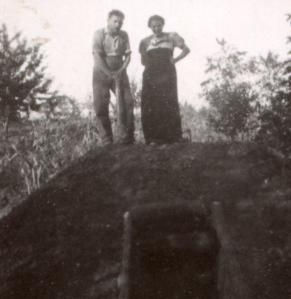
8. In September 1944 my grandparents and parents moved into this dugout, a small shack in the middle of a vineyard at the Valley of Yuko. It contained a small wood burning stove and two single beds made out of rough timber. They were forced to move to a larger place when others arrived, looking for a safe heaven.

9. By the end of October 1944, a few weeks after a fascist take over of Hungary, the number of people in the farmhouse that my grandmother rented in Majlath, the Kopácsi hideout grew from the original six to thirteen, including seven Jews, an escaped soldier, a union leader and an injured Soviet Soldier. They became one of the groups of the MOKAN Committee; a Miskolc based broad based organization, whose members included socialist, communists, army defectors, soldiers loyal to Admiral Horthy and young army cadets, as well as ordinary citizens, who were engaged in sabotaging shipments to Germany of war material produced in the steel factory and that it had its own press, which churned out thousands of anti-fascist pamphlets.

10. Gregory the Soviet Soldier my parents befriended in the end of 1944.
On November 17, 1944 the seventh Soviet motorized army corps and the fifth cavalry corps arrived in Miskolc and met my father’s group. Captain Ustinov requested a detailed map of the city with the exact location of the German weaponry marked on it. The leaders of the MOKAN, with the help of the National Guard, quickly drew up this map and delivered it to them. It was used by the Soviet artillery and air forces to successfully eliminate these German military objectives, thus saving the town the unnecessary suffering of a long siege. December 3, 1944, the German Commander of the region, estimating the MOKAN to be a strong force of twenty thousand instead of the no more than five hundred it was, evacuated the area.
On November 17, 1944 the seventh Soviet motorized army corps and the fifth cavalry corps arrived in Miskolc and met my father’s group. Captain Ustinov requested a detailed map of the city with the exact location of the German weaponry marked on it. The leaders of the MOKAN, with the help of the National Guard, quickly drew up this map and delivered it to them. It was used by the Soviet artillery and air forces to successfully eliminate these German military objectives, thus saving the town the unnecessary suffering of a long siege. December 3, 1944, the German Commander of the region, estimating the MOKAN to be a strong force of twenty thousand instead of the no more than five hundred it was, evacuated the area.

11. The MOKAN were the only resistance group in Hungary allowed by the Russian Army to keep their weapons after the war. In January of 1945, the fighters of the MOKAN group became part of the law enforcement apparatus of the new Republic of Hungary. Thus, my father became a police officer.

12. Walking hand in hand with my father at the age of two. From the day I was born till the day he died we were comrades in arms.

13. Dec 1954, at the tenth anniversary of the MOKAN, the gathering in front of the farm house in Majlath.

14. Summer of 1955, my Kopácsi great-grandfather, my Kopácsi Grandfather and my father, side by side during a visit to Miskolc, our home town. My Great-grandfather died the following year in February 1956 and my grandfather in March 24, 1963, a day before my father’s release from prison.

15. A rare photo of in the summer of 1955, while visiting the family plots in the cemetery
four generations of Kopacsis are standing together
four generations of Kopacsis are standing together

16. A march by university students in Budapest on 23 October became a spontaneous
national uprising against Soviet rule.
national uprising against Soviet rule.

17. On the eve of the revolution, October 23 1956 at least a hundred thousand people
gathered together on the square to get rid of the statue of Stalin.
gathered together on the square to get rid of the statue of Stalin.

18. October 28, 1956. After the initial bout of fighting had stopped and the Hungarian
people believed that the revolution succeeded people are once again free to walk the
street of Budapest. Within days the Soviet army came back to crush their short lived
freedom
people believed that the revolution succeeded people are once again free to walk the
street of Budapest. Within days the Soviet army came back to crush their short lived
freedom

19. October 26. 1956
Open boxes set up to collect money for the widows and orphans of the fallen Hungarian
Revolutionists sit unattended on street corners. A passerby is adding to the collection.
The caption above the box states: The dignity of our revolution allows us to collect money
in such a decent manner for our martyrs’ widows and orphans
Open boxes set up to collect money for the widows and orphans of the fallen Hungarian
Revolutionists sit unattended on street corners. A passerby is adding to the collection.
The caption above the box states: The dignity of our revolution allows us to collect money
in such a decent manner for our martyrs’ widows and orphans

20. 1956 October 28, my father as the Chief of Police of Budapest is in the midst of
negotiation with members of the Revolutionary worker’s council from the town of
Csepel.
negotiation with members of the Revolutionary worker’s council from the town of
Csepel.

21. Yugoslav Embassy in Budapest, where Imre Nagy and the rest of the revolutionary
government found refuge from the Russian invasion on November 4, 1956. I was taken
there by my father’s friend Joseph Szilágyi. When I got sick ten days later, I was
smuggled out to my grandparents. On November 22 Imre Nagy and the rest of the
people hiding there were trapped by the Russians and instead of allowing them to return
home safely, arrested and kidnapped them to Rumania.
government found refuge from the Russian invasion on November 4, 1956. I was taken
there by my father’s friend Joseph Szilágyi. When I got sick ten days later, I was
smuggled out to my grandparents. On November 22 Imre Nagy and the rest of the
people hiding there were trapped by the Russians and instead of allowing them to return
home safely, arrested and kidnapped them to Rumania.

22. February 1957 a few months after my Father’s arrest I finally go back to school. I
have to face the world and find out who my real friends are.
have to face the world and find out who my real friends are.

23. In 1958 my mother is making living by selling pretzel in the Budapest Zoo. She made
a good living as she was stationed in front of the zebras’ pen and in those days the
relatives and friends of the many thousands of political prisoners often visited the Zoo
and fed the Zebras, as they were reminding them of their loved ones wearing the striped
prison uniforms.
a good living as she was stationed in front of the zebras’ pen and in those days the
relatives and friends of the many thousands of political prisoners often visited the Zoo
and fed the Zebras, as they were reminding them of their loved ones wearing the striped
prison uniforms.

24. In the spring of 1963, seven years later my father is released during a general
amnesty. One day before his release my grandfather died of his fifth heart attack. My
father’s first walk as a free man after seven year of imprisonment, were behind my
grandfather’s coffin.
amnesty. One day before his release my grandfather died of his fifth heart attack. My
father’s first walk as a free man after seven year of imprisonment, were behind my
grandfather’s coffin.

25. My high school graduation picture doesn’t show the tribulations I had to face during
those years. Continually singled out and harassed by classmates and teachers I often
thought of suicide.
those years. Continually singled out and harassed by classmates and teachers I often
thought of suicide.
bottom of page